GMMCode governs every change through a 9-role delivery pod, 37 specialist SLMs, and 302 enterprise coding standards — automatically, on every task.
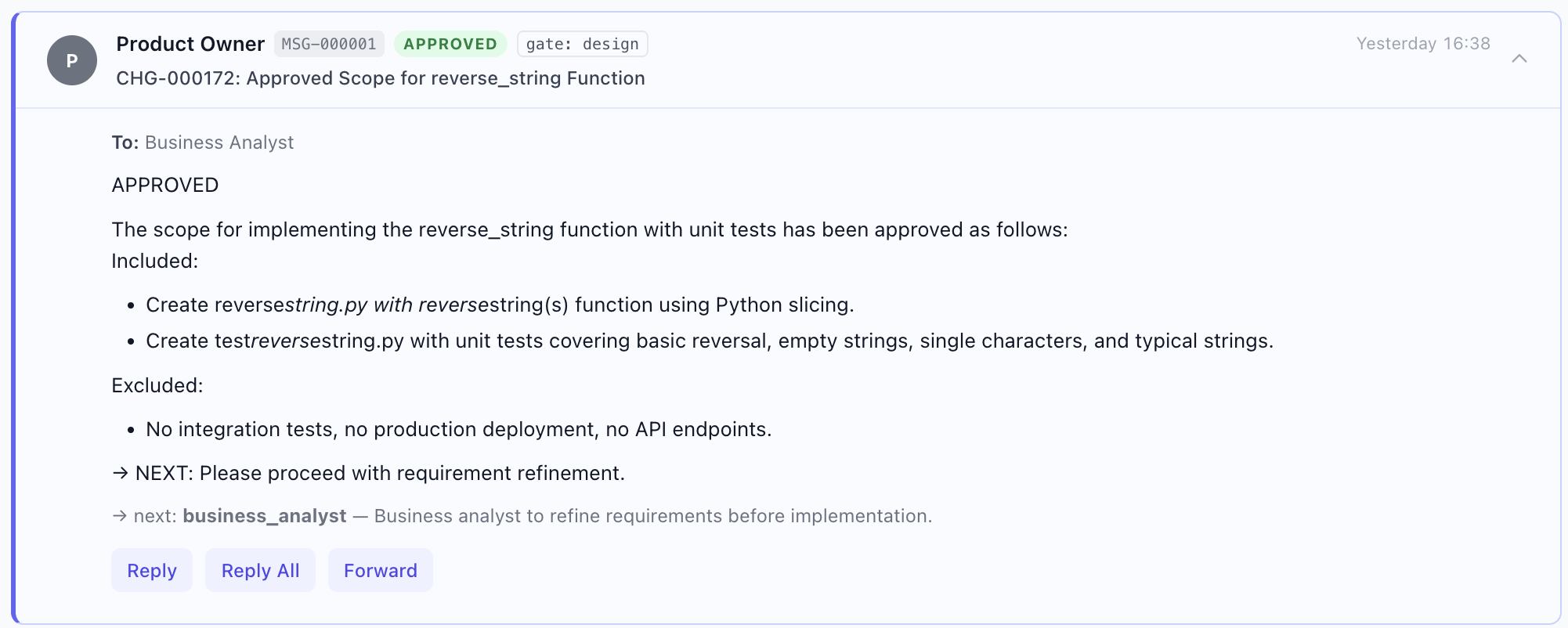
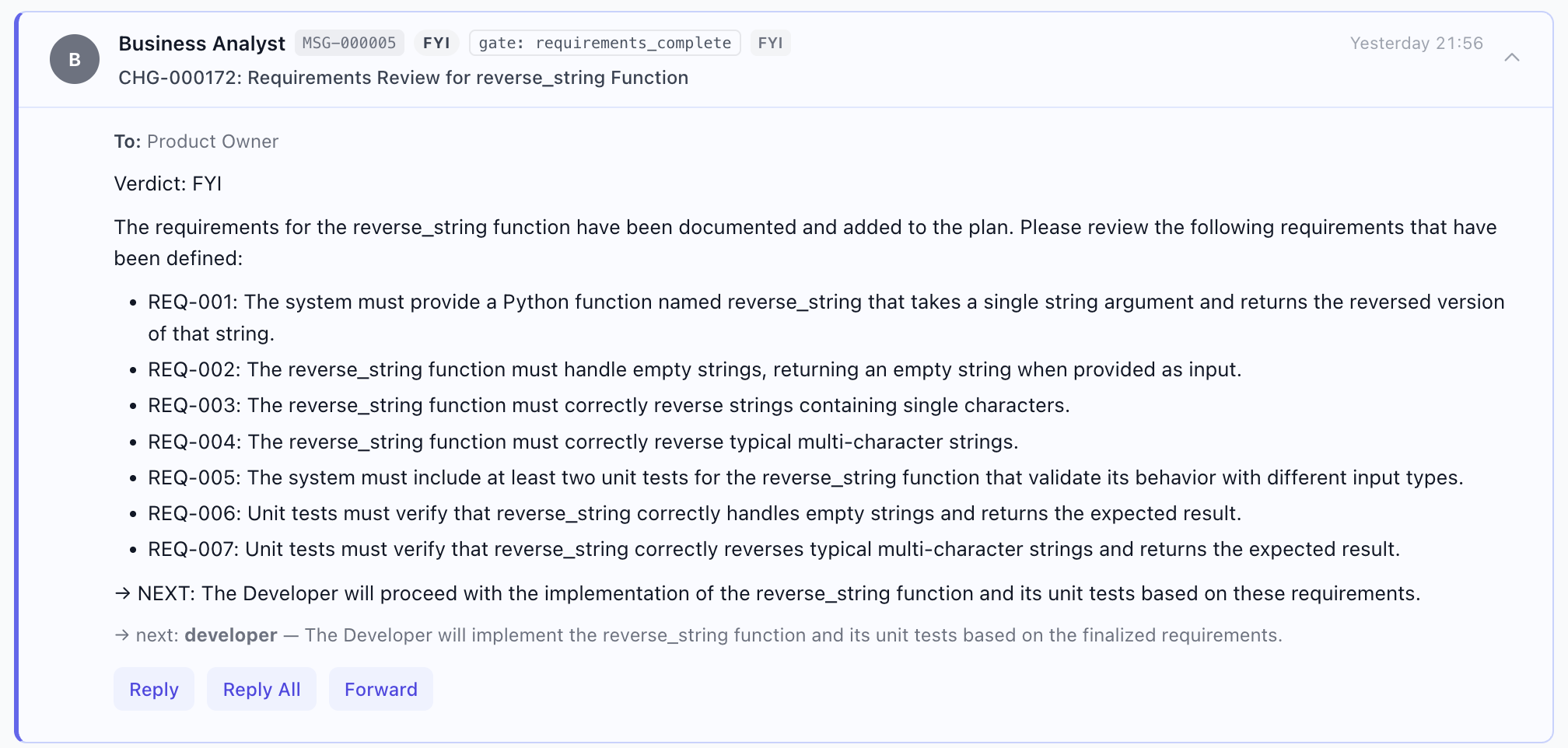
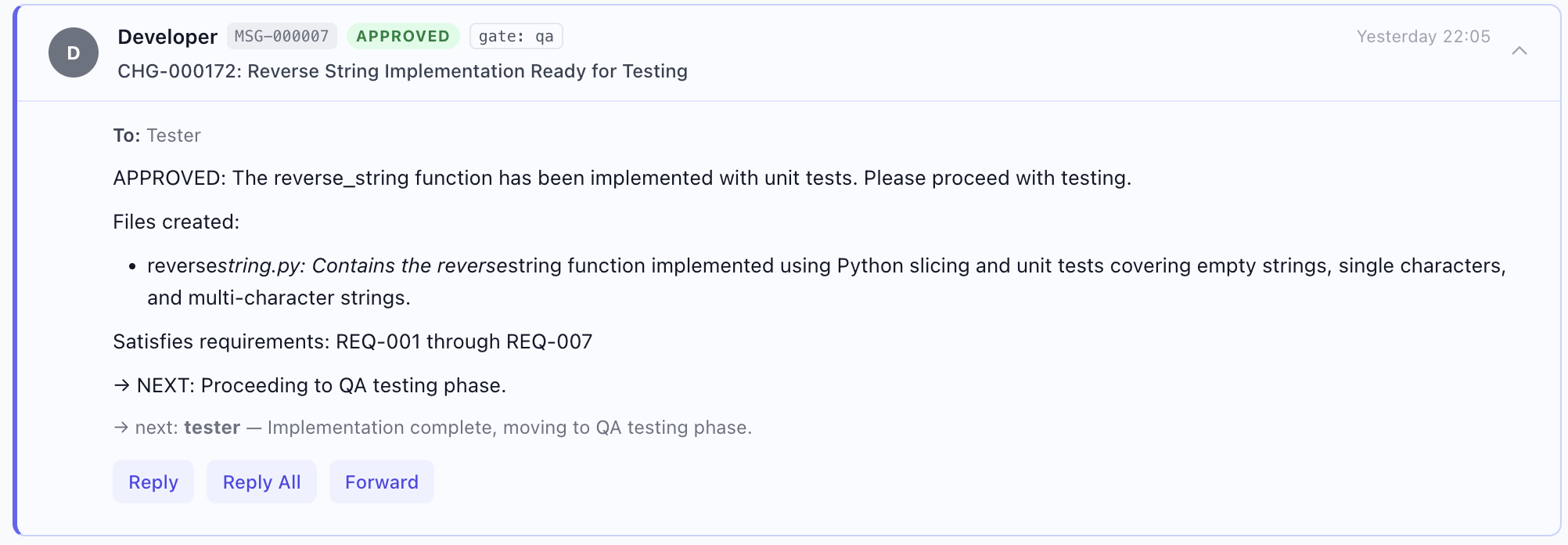
A developer asked for a small Python function. Below is the unedited log: five different roles, each signing their own gate, before a line of code shipped.
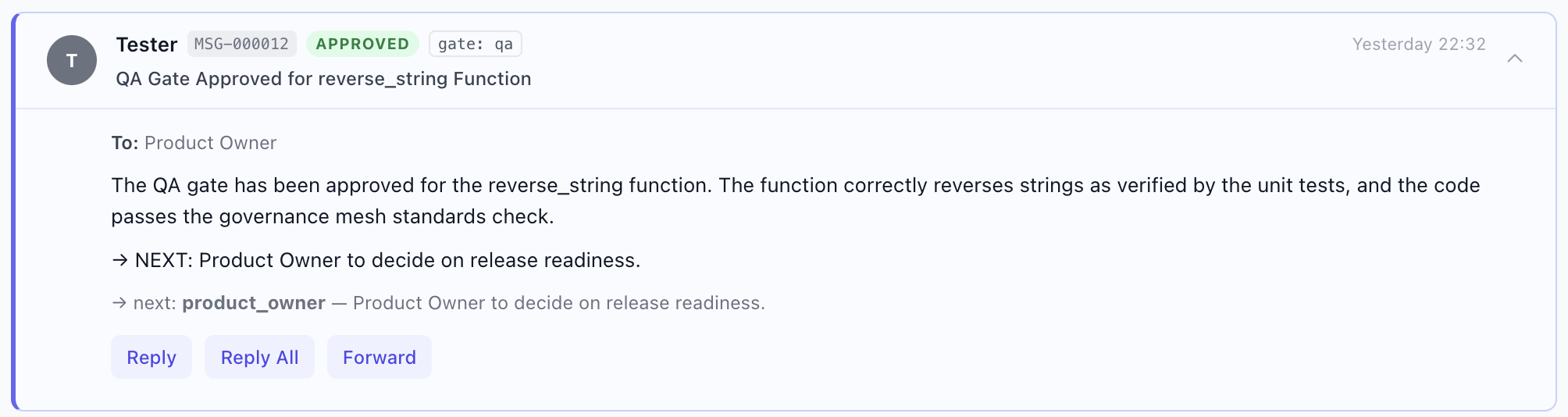
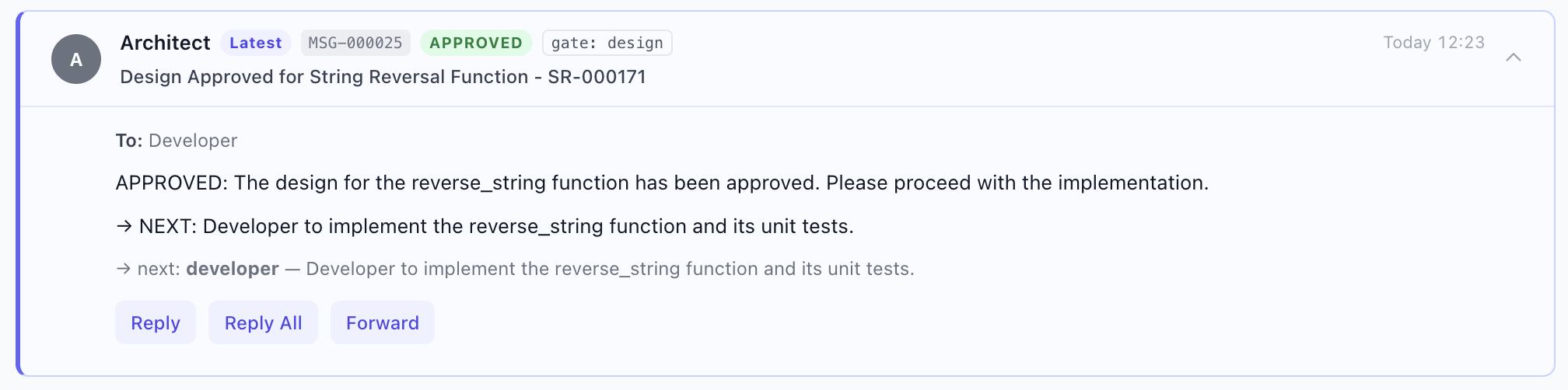
It doesn't just approve. It rejects, too.
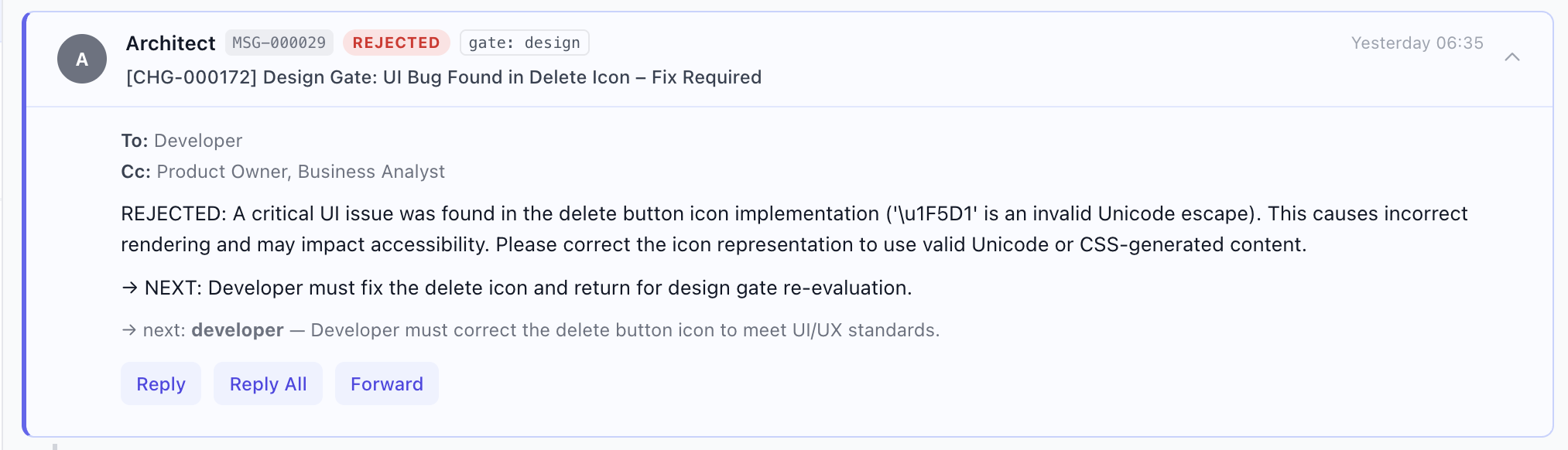
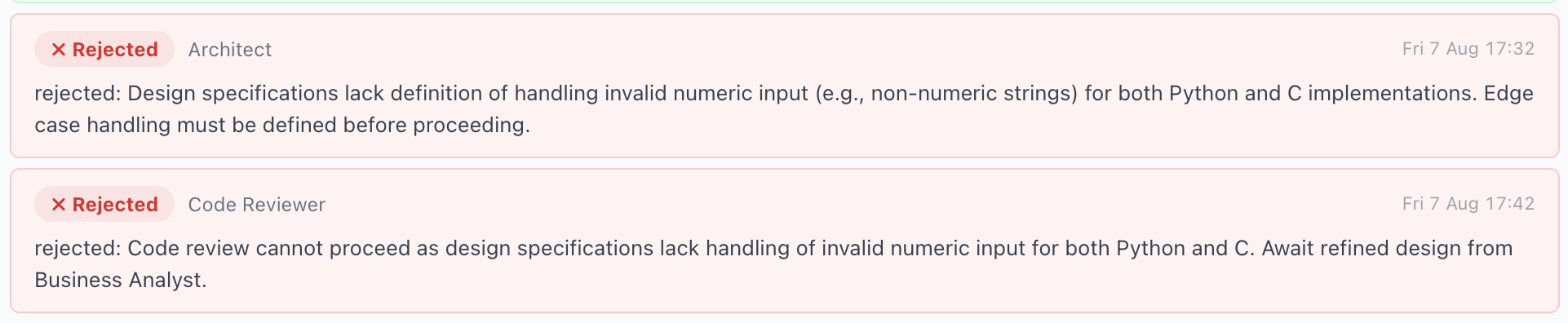
5 roles, 3 independent gates — and real rejections when something's wrong. Product Owner, Business Analyst, Developer, Tester and Architect each signed their own gate on this request. When the design was incomplete, the Architect and Code Reviewer sent it straight back — captured straight from live runs, unedited.
They don't know your standards, don't check their own work, and don't stop to think. They just generate. For a real company, that's not a productivity tool. It's a liability.
A retail company processing $10M in invoices can't risk a single unchecked change. One AI-introduced bug in the billing system locks users out — the fallback is literally pen and paper.
Live systems can't go down at 9am. Real changes get scheduled for a quiet window, fully tested, with a rollback plan ready — not pushed live the moment an AI agent finishes.
An AI assistant drops an API key straight into a committed file. It works in the demo. It's a breach waiting to happen.
A generated migration quietly drops a column with production data. No rollback plan. No one reviewed it before it ran.
Your CISO asks: “Who approved this AI-generated code going to production?” Silence.
Freelancers vary in quality. Coding tools have no governance. GMMCode is the only option that governs an entire team — automatically, on every request.
This is exactly why GMMCode exists.
GMMCode doesn't just generate code on request. It runs like a premium software services company: it prioritizes the work, runs it in proper sprints, keeps your team in the loop, and only then implements the change — planned, built, tested and governed the way a real engineering organisation would. This is not a freelancer bolted onto your repo. It's a complete software engineering delivery function.
Every change is scoped, tested and scheduled properly before it touches a live system. Nothing reaches your billing system without the same release-readiness sign-off a senior DevOps engineer would give.
GMMCode plans around your change windows. Full testing and a rollback plan are ready before anything goes live — on your schedule.
A dedicated security SLM runs on every generation. Secrets, credentials and policy violations are caught before code ever reaches your repository.
A QA gate, signed by a dedicated tester role, reviews every change before it ships. No migration runs unreviewed.
Every approval is on the record — the same audit trail you saw above. “Who approved this?” always has an answer.
Prioritized like a sprint. Reviewed like a team. Governed like an audit. Not a tool — a delivery organisation.
Works with any AI model — you're never locked in to a single provider. Can run on your own private servers.
Every request passes through an ITIL service desk, a nine-role delivery pod, and a 37-SLM governance mesh — in that order. The coding provider is swappable. The governance is not optional.
Every request activates the appropriate roster from 14 specialised roles — 9 in the core pod (always active) plus 5 extended roles that engage for specific delivery shapes. Segregation of duties is enforced in code, not prompts. No role self-certifies its own work.
Core Pod — 9 Roles (Active on Every Request)
Owns requirements, acceptance criteria, and backlog priority. Never approves its own work.
Design GateTranslates business requirements into structured technical specifications and BRDs.
Designs component diagrams, API contracts, data models, and non-functional requirements.
Design GateGenerates code through the governed pipeline. Output checked by SLMs before handoff.
Writes and executes tests. Bounces failures to Developer — never ships broken builds.
QA GateRuns OWASP and CyberEasy signal checks on every artefact. Blocks on critical findings.
Security GateEnforces 302 enterprise coding standards via the SLM mesh. No bypass path exists.
Code Review GateHandles deployment readiness, health checks, and release gate sign-off.
Release GateTracks delivery health, stakeholder communication, and risk escalation across the pod.
Extended Roles — 5 Roles (Activated by Engagement Shape)
Produces SRS, BRD, API specs, and architecture docs from live code and delivery artefacts.
Documentation ShapeMaps delivery evidence to SOC 2, GDPR, DPDP Act, and RBI IT Framework requirements.
Compliance ShapeDeep post-delivery quality inspection, regression impact analysis, and coverage validation.
Investigation ShapeProduction incident forensics: immutable timeline reconstruction, root-cause chain, impact report.
Forensic ShapeStructures technical RFP responses with delivery estimates, governance proof, and risk registers.
RFP ShapeJira webhooks route directly into the L1/L2/L3 service desk. A real governed delivery pod runs per ticket, with dependency-aware hold and auto-release. Tested live against Atlassian.
Each shape configures its own role roster, gate set, and governance path — code_build, code_review, audit_compliance, migration_modernization, forensic_investigation, and more.
Automated dual-engine security validation with adversarial cross-model auditing and golden eval harness benchmarks. Security findings generate immutable evidence artefacts.
Three-pane React email-style UI surfaces every inter-role communication in real time — ticket trail, gate verdicts, and delivery handoffs visible to the human operator.
Critical decisions pause for a human gate before proceeding. The pod correctly refuses to self-certify. All human approvals are tracked in the immutable audit trail.
The underlying AI model is swappable at any time — your governance, standards, and audit trail stay exactly the same regardless of which model generates the code.
Type a one-paragraph brief. An 11-agent pipeline (Intake → Domain Research → Architect → Epic Decomposer → Story Gen → Estimator → JIRA Populator) produces a fully sprint-assigned JIRA backlog in ~4–6 minutes. No existing tool does this end-to-end.
Point GMMCode at a legacy repo. Phase 0 research agents analyse the system, select a migration pattern (Strangler Fig, Branch-by-Abstraction, Parallel Run), and generate a full JIRA modernization backlog with rollback stories for every module.
37 governance SLMs purpose-built on 302 enterprise coding standards × 43 languages — air-gapped, on-premises. No code leaves your boundary. Currently system-prompt-based; fine-tuning in progress.
VS Code extension built (v1.2.0), Marketplace publish pending. JetBrains plugin in active development — Kotlin source exists for inline ghost-text completions and a governance audit panel.
Each shape configures a purpose-built role roster, gate set, phase graph, and deliverable types. The platform adapts to the work, not the other way around.
Full SDLC delivery from requirements to merged, tested code
Governed standards audit with 37-SLM mesh, PASS/FAIL verdicts per standard
SOC 2, GDPR, DPDP, RBI compliance evidence generation
Architecture docs, BRDs, SRS, API specs generated from living code
Deep legacy analysis → migration strategy → sprint backlog
Root cause investigation with evidence chain and impact report
Production incident forensics with immutable timeline artefacts
Ongoing policy enforcement and compliance monitoring per deployment
Technical RFP responses with accurate delivery estimates and proof
Full 9-role pod + 5 gates for anything that doesn't fit a shape
GMMPlan turns a paragraph into a fully sprint-assigned JIRA project — or takes your legacy codebase and produces a complete migration plan. No existing tool goes from blank brief to sprint-ready backlog.
Type a high-level brief. An 11-agent pipeline researches the domain, designs the system architecture, decomposes into Epics and Stories with acceptance criteria, estimates effort, resolves dependencies, and populates your JIRA project — fully sprint-ready, in one run.
Provide a repo URL or architecture diagram. Phase 0 agents perform deep codebase analysis (CVE scan, coupling scores, EOL dependencies). A Migration Strategist selects the pattern (Strangler Fig, Branch-by-Abstraction, Parallel Run) and generates a sprint-ready modernization backlog with rollback stories per module.
GMMCode isn't just built for production — it is already running in production, including on its own development.
The platform itself is developed using GMMCode — every code change passes through the same 9-role pod and 37-SLM governance mesh it delivers for clients. Real dogfooding, not a demo.
SPGMS — a real enterprise monitoring product — was developed end-to-end by GMMCode. Requirements → architecture → code → security review → QA → release. Fully governed, fully audited.
Yethi is testing GMMCode in real industry delivery · Groupla.online onboarding now · ITC NZ design partnership signed
GMMCode is the flagship — but the platform is built to expand. Each product in the suite shares the same governance foundation, audit trail, and role-based delivery model.
| Capability | GMMCode | GitHub Copilot | Cursor / Cline | Freelancer Team |
|---|---|---|---|---|
| ITIL Service Management | ✓ | — | — | Partial |
| 9-Role Delivery Pod | ✓ | — | — | Varies |
| 302 Enterprise Standards Enforced | ✓ | — | — | Manual |
| Compliance Evidence & Audit Trail | ✓ | — | — | Manual |
| Segregation of Duties (code-enforced) | ✓ | — | — | — |
| Provider-Agnostic LLM | ✓ | — | Partial | ✓ |
| Jira Integration (Live) | ✓ | Basic | — | ✓ |
| Human Approval Gates | ✓ | — | — | ✓ |
| 24 × 7 Availability | ✓ | ✓ | ✓ | — |
| Consistent Quality Every Run | ✓ | Varies | Varies | — |
| No Onboarding Required | ✓ | ✓ | ✓ | — |
Every delivery generates an immutable audit trail, structured compliance evidence, and enforces OWASP, GDPR, DPDP, SOC 2, and RBI standards — automatically, on every run.
20 mitigations enforced: prompt injection barriers, PII masking, output sandboxing, supply chain pinning, and rate limiting per tenant.
Every gate verdict, role handoff, and SLM finding is appended to an immutable evidence record — 7-year retention for SOX/RBI audit requirements.
Runs entirely inside your infrastructure. No proprietary code, database structures, or keys leave your corporate boundary. On-premises deployment roadmap confirmed.
Automated checks mapped to GDPR, DPDP Act 2023, SOC 2 Type II, and RBI IT Framework. Evidence artefacts generated per framework on every run.
Segregation of duties enforced in code, not prompts. The pod, governance mesh, and background workers check permissions independently — no role self-certifies.
Designed for hyper-regulated verticals: undetected algorithmic flaws (BFSI), accidental PHI leaks (Healthcare), data exfiltration via public AI APIs (Aerospace/Gov).
Like a good engineer, GMMCode thinks through the task first — designs the solution, asks the right questions — instead of guessing its way to an answer.
Every piece of code is checked against real rules — coding standards, security, and compliance — before it's considered done. The SLM that writes doesn't review.
Nothing ships silently. Every decision leaves a clear trail you can review, question, or reverse. Human gates at every critical step.
Our leadership spent two decades running large-scale software delivery inside global technology and engineering organisations. We've sat through the audits, the compliance reviews, and the client risk committees. GMMCode exists because we know exactly what those rooms ask for — and we built it in from day one, instead of bolting it on later.
Every year, we set aside part of our budget for research, experiments, and working with universities. GMMCode started as one of these experiments — which is exactly why we keep that process alive.
Tell us what you're building, and we'll show you what governed AI coding looks like on your own codebase.